Saturday, March 30, 2019

5 Top Stock Trades for Friday: BB, PVH, MU, VZ and LULU

It’s another up-and-down day as investors try to weigh what seems to be a strong U.S. economy and weakening global economy. This of course, makes it tough to bid up stocks to new highs, but at the same time, it’s hard to sell U.S. equities when it’s the best house in the neighborhood. That said, we had some big movers on Thursday. Let’s look at them as part of our top stock trades lineup.

Top Stock Trades for Tomorrow #1: PVH Corp

top stock trades for PVHtop stock trades for PVH

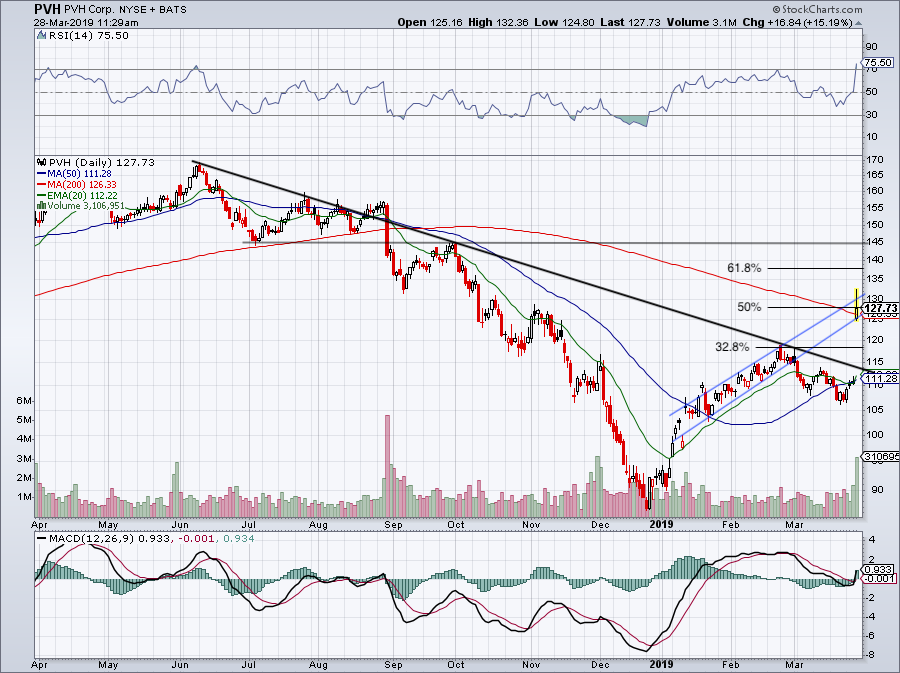
A top- and bottom-line earnings beat propelled PVH Corp (NYSE:PVH) shares higher on Thursday, up about 15% on the day. However, shares are fading from the session highs.

For now, the stock is clinging to its 200-day moving average, and bulls surely want to see PVH maintain this level going into the weekend. What if it doesn’t?

If PVH can’t maintain its post-earnings day range, it could pullback to the $120-ish level. Down near $118 is the 31.8% Fibonacci retracement, which could step in as support. Below that is the 20-day and 50-day moving averages, and while PVH is still technically okay on a pullback that far, bulls will not be feeling good to give up almost all of the stock’s earnings gains.

On the upside, over $130 could ignite a continuation trade higher. Right now, PVH is trading back into the relatively tight channel extension from January and February. But over $130 puts PVH over the 50% retracement, as well as channel resistance. That could spark a run to $138 and potentially $145.


Compare Brokers

Top Stock Trades for Tomorrow #2: BlackBerrytop stock trades for BBtop stock trades for BB

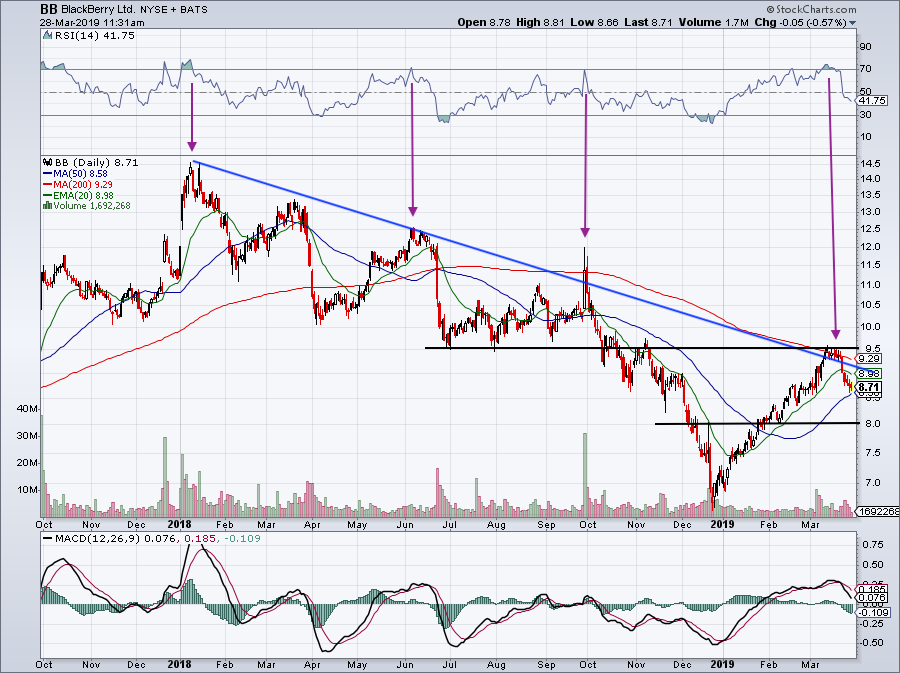
BlackBerry (NYSE:BB) will report earnings on Friday before the open. What can investors expect?

Downtrend resistance (blue line) has kept a lid on BlackBerry for more than a year. For now, BB is clinging to the 50-day, but hasn’t been able to meaningfully climb above the 200-day moving average since last May.

Should earnings disappoint investors, the 50-day level will give way and the $8 level will be in focus. That would represent an 8% decline from current levels if it gets there. On a rally, it would be encouraging to see BB close north of $9.50. That would require a 9% rally and put $10+ on the table. Worth noting is that the 50% retracement level sits near $9.98.


Compare Brokers
Top Stock Trades for Tomorrow #3: Micron

top stock trades for MUtop stock trades for MU

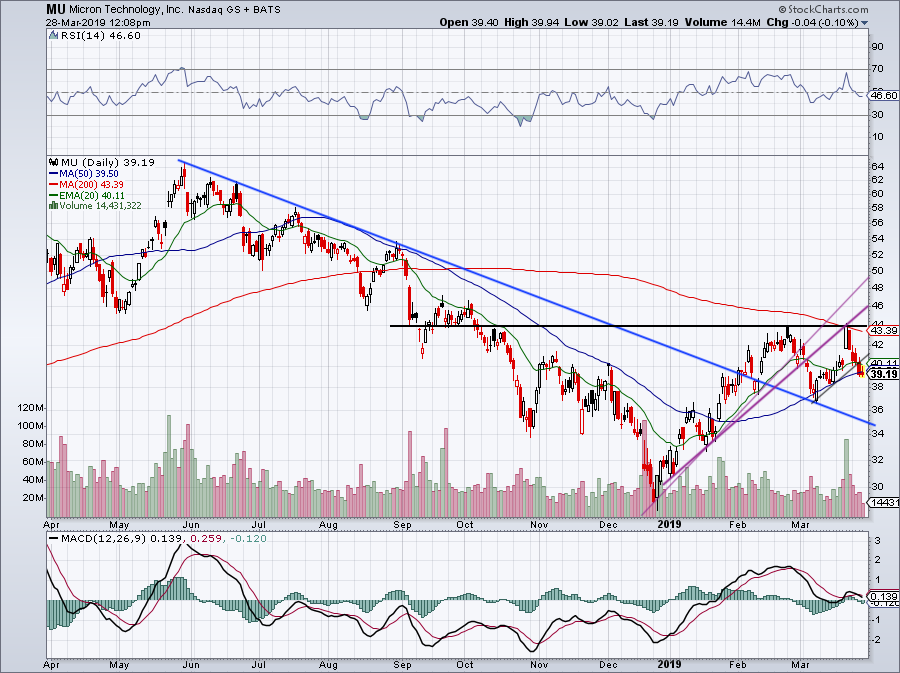
Micron (NASDAQ:MU) isn’t looking great right now. The post-earnings pop last week rallied Micron right to the 200-day moving average, where it promptly failed a day later.

Just a few sessions later and Micron is teetering on the 50-day moving average and looking awfully likely to break down further from here. That’s despite strength in the semis, an earnings and revenue beat with reiterated guidance, and even an analyst expressing optimism for the MU in the second half of 2019 on Thursday.

If these catalysts can’t keep MU stock up, what can? If MU does indeed break down, the March lows near $36.50 are the first target. Below that, the backside of prior downtrend resistance (blue line) would be the next target. On the upside, we need to see MU above the 50-day. If it can do that, the 200-day is the next test.


Compare Brokers
Top Stock Trades for Tomorrow #4: Lululemon

top stock trades for LULUtop stock trades for LULU

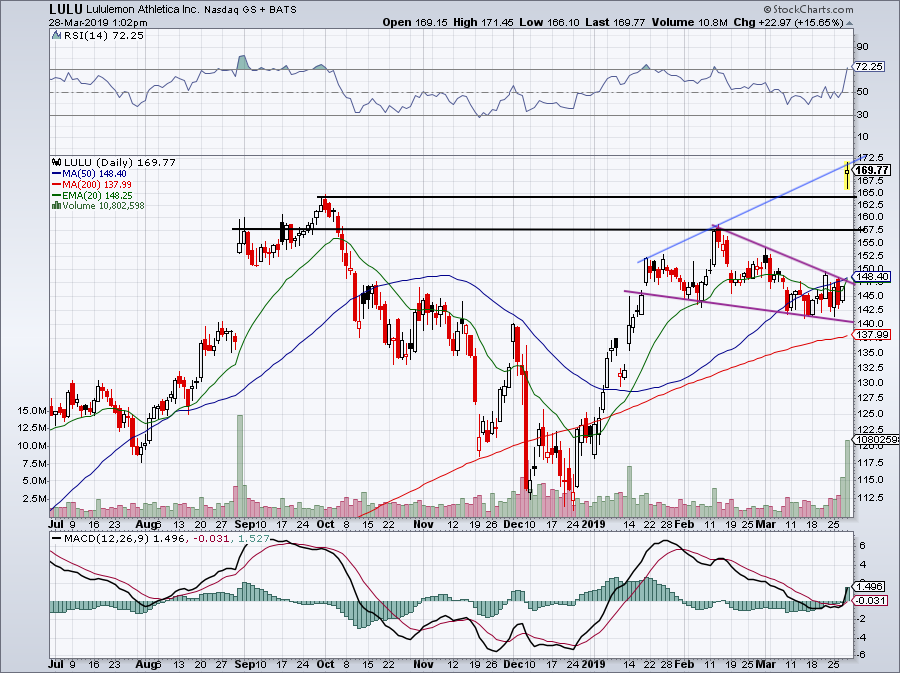
Lululemon Athletica (NASDAQ:LULU,) jumped more than 15% on Thursday after better-than-expected earnings results. Full-year guidance also impressed the Street, sending shares to new all-time highs. Now what?

With a strong report and strong price action to boot, it’s clear that Lululemon’s business and stock price have momentum. Bulls need to see the stock maintain $165+ in order for that momentum to continue. While it wouldn’t be bad to see some sideways price action before a continuation higher, losing the $165 level — the prior highs from October — would certainly be discouraging after such a solid report. If it does, the $157.50 level will be in focus.

On the upside, let’s see if LULU can take out its Thursday highs. Short of a market-wide correction or an unforeseen event, LULU stock should continue higher over time. Bulls are definitely in control right now, even if it needs time before pushing meaningfully higher. 


Compare Brokers
Top Stock Trades for Tomorrow #5: Verizon

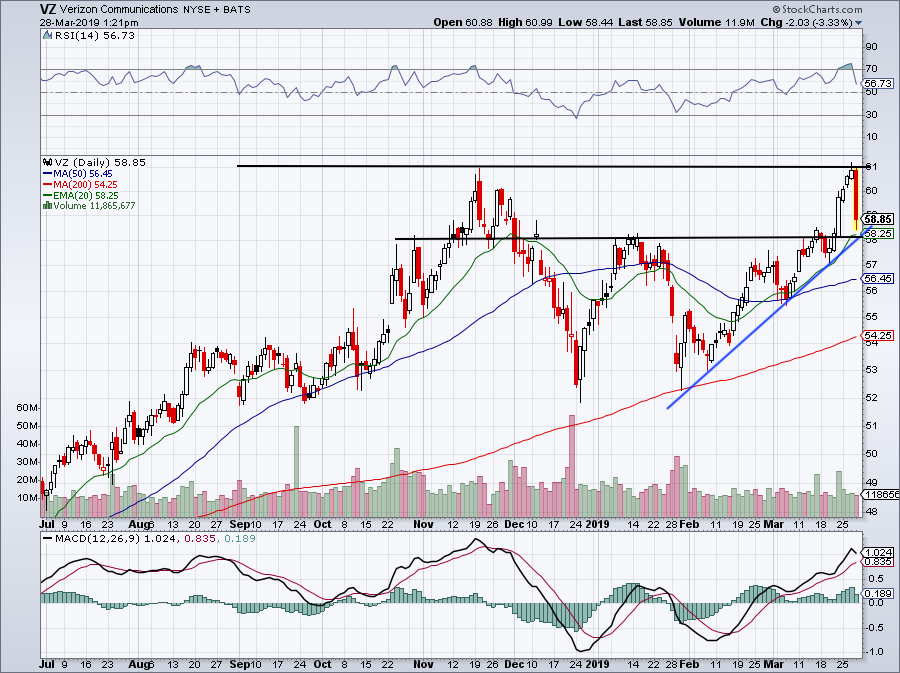
Shares of Verizon (NYSE:VZ) are down more than 3% on Thursday, as AT&T (NYSE:T), T-Mobile (NYSE:TMUS) and others in the sector come under pressure. Shares failed right at its prior highs near $61 and are now pulling back.

Not that VZ is a big mover or a generally a “top trade” candidate, but it could see buyers step in soon. High-yield stocks are in demand and VZ is coming into a key area. Near $58 it has uptrend support (blue line), a key level (black line) and the 20-day moving average. I don’t know if it will get there, but I would love to buy on a test of the 200-day. 

Bret Kenwell is the manager and author of Future Blue Chips and is on Twitter @BretKenwell. As of this writing, Bret Kenwel

Monday, March 25, 2019

Buy Domino's Pizza For Fantastic Total Return And Steady Growth

This article is about Domino's Pizza (DPZ) and why it's a great buy for the total return investor that also wants some dividend income. Domino's Pizza is one of the largest fast food companies in the United States and foreign countries.

Domino's Pizza will be evaluated using The Good Business Portfolio guidelines, my IRA portfolio of good business companies that are balanced among all styles of investing. The company has steady growth and has cash it uses to increase the dividends each year and open new stores.

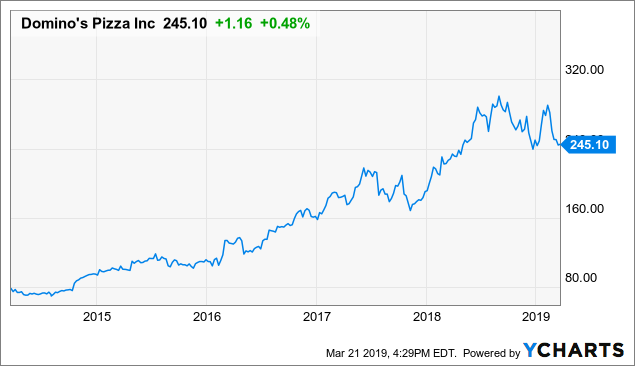
When I scanned the five-year chart, Domino's Pizza has a good chart going up and to the right on a strong upslope from 2015 through to date. This is the kind of chart I like showing the defensive nature of their business with straight line growth.

Chart Data by YCharts

Fundamentals of Domino's Pizza will be reviewed on the following topics below.

The Good Business Portfolio Guidelines Total Return and Yearly Dividend Last Quarter's Earnings Company Business Takeaways Recent Portfolio Changes

I use a set of guidelines that I codified over the last few years to review the companies in The Good Business Portfolio (my portfolio) and other companies that I am reviewing. For a complete set of the guidelines, please see my article " The Good Business Portfolio: Update to Guidelines, August 2018". These guidelines provide me with a balanced portfolio of income, defensive, total return and growing companies that hopefully keeps me ahead of the Dow average.

Good Business Portfolio Guidelines

Domino's Pizza International passes 10 of 11 Good Business Portfolio Guidelines, a good score (a good score is 10 or 11). These guidelines are only used to filter companies to be considered in the portfolio. Some of the points brought out by the guidelines are shown below.

Domino's Pizza does not meet my dividend guideline of having dividends increase for 8 of the last ten years and having a minimum of 1% yield, with seven years of increasing dividends and a 1.1% yield. Domino's Pizza is, therefore, a good choice for the dividend income investor because the dividend growth is 22% over the past 5 years and next year should easily pass this guideline. The three-year average payout ratio is low at 25%. After paying the dividend, this leaves plenty of cash remaining for increasing the business by opening new stores. I have a capitalization guideline where the capitalization must be greater than $10 Billion. DPZ passes this guideline. DPZ is a mid-cap company with a capitalization of $10.1 Billion. Domino's Pizza 2019 projected cash flow at $400 Million is good allowing the company to have the means for company growth and increased dividends. I also require the CAGR going forward to be able to cover my yearly expenses and my RMD with a CAGR of 7%. My dividends provide 3.3% of the portfolio as income, and I need 1.9% more for a yearly distribution of 5.2% plus an inflation cushion of 1.8%. The three-year forward CAGR of 17% meets my guideline requirement. This good future growth for Domino's Pizza can continue its uptrend benefiting from the continued growth in the worldwide economy. My total return guideline is that total return must be greater than the Dow's total return over my test period. DPZ passes this guideline since their total return is 153.85%, much more than the Dow's total return of 44.04%. Looking back five years, $10,000 invested five years ago would now be worth over $32,400 today. This makes Domino's Pizza a good investment for the total return investor looking back, that has future growth as the economy continues to grow. One of my guidelines is that the S&P rating must be three stars or better. DPZ's S&P CFRA rating is three stars or hold with a target price to $275, passing the guideline. DPZ's price is presently 12% below the target. DPZ is under the target price at present and has a high PE of 25, making DPZ a fair buy at this entry point for the long term growth investor that wants good steady increasing dividends and future total return growth. One of my guidelines is would I buy the whole company if I could. The answer is yes. The total return is great, and the below average growing dividend makes DPZ a good business to own for income and growth. The Good Business Portfolio likes to embrace all kinds of investment styles but concentrates on buying businesses that can be understood, makes a fair profit, invests profits back into the business and also generates a good income stream. Most of all what makes DPZ interesting is the potential long-term growth of their business as the working population and the worldwide economy increases. Total Return and Yearly Dividend

The Good Business Portfolio Guidelines are just a screen to start with and not absolute rules. When I look at a company, the total return is a key parameter to see if it fits the objective of the Good Business Portfolio. Domino's Pizza passes this total return guideline against the Dow baseline in my 51-month test. I chose the 51 month test period (starting January 1, 2015, and ending to date) because it includes the great year of 2017, and other years that had fair and bad performance. The good total return of 153.85% makes Domino's Pizza a great investment for the total return investor that also wants a steadily increasing income. DPZ has a below average dividend yield of 1.1% and has had increases for seven years making DPZ also a fair choice for the dividend investor. The Dividend was increased February 2019 to $0.65/Qtr. from $0.55/Qtr. or an 18% increase.

DOW's 51 Month total return baseline is 44.04%

Company Name

51 Month total return

The difference from DOW baseline

Yearly Dividend percentage

Domino's Pizza

153.85%

+109.81%

1.1%

Click to enlarge

Last Quarter's Earnings

For the last quarter on February 21, 2019, Domino's Pizza reported earnings that missed expected by $0.07 at $2.62 and compared to last year at $2.09. Total revenue was higher at $1.09 Billion up more than a year ago by 21.38% year over year and missed expected revenue by $7.9 Million. This was a mixed report with the bottom line increasing over last year but missing expected earnings and the top line increasing. The next earnings report will be out late May 2019 and is expected to be $2.14 compared to last year at $2.00.

Business Overview

Domino's Pizza is one of the largest fast food companies in the United States and foreign countries.

As per excerpts from Reuters

Domino's Pizza is a pizza restaurant chain company. As of January 1, 2017, the Company operated in over 13,800 locations in over 85 markets around the world.

The Company operates through three segments: domestic stores, an international franchise, and supply chain. Its basic menu features pizza products in various sizes and crust types. Its stores also offer oven-baked sandwiches, pasta, boneless chicken and wings, bread side items, desserts, and soft drink products.

International markets vary toppings by country and culture, such as squid toppings in Japan or spicy cheese in India, and feature regional specialty items, such as a banana and cinnamon dessert pizza in Brazil."

Overall Domino's Pizza is a good business with 17% CAGR projected growth as the United States and foreign economies grow going forward, with the increasing demand for DPZ's fast food. The below average dividend income brings you cash as we continue to see further growth as the world economy grows.

The FED has kept interest rates low for some years, and on December 19, 2018, they raised the base rate of 0.25%, which was expected. I believe that they will go slow in 2019, which should help keep the economy on a growth path. If infrastructure spending can be increased, this will even increase the United States growth going forward with better economics for the consumer. At the March 20 meeting, the FED lowered United States GDP projection for 2019 which may mean they are getting to neutral on the economy, projecting no rate increases for 2019. The FED meeting Statement was a wait and see and a bit more dovish than the last meeting.

From February 21, 2019, earnings call Rich Allison (Chief Executive Officer and President) said

I'm pleased with what was a terrific fourth quarter, one that capped another outstanding year for Domino's. Our results continue to outpace the industry and our franchisees across the globe continue to make me extremely proud.

Retail sales growth matters, and once again we delivered. Our global retail sales growth reflected a strong balance, across our US and international businesses. For both businesses in Q4, our growth reflected a healthy blend of unit growth and traffic driven same-store sales. Looking first at our US business, double-digit retail sales growth in Q4 was comprised of a very healthy and order count driven 5.6% comp and 125 net new units.

Turning now to International, we delivered strong retail sales growth for the fourth quarter and a double-digit result for the whole year. Fourth quarter net unit openings were particularly strong and represented a significant acceleration over previous quarters. Same-store sales performance can certainly improve versus what we have all come to expect, but I'm pleased to see all of our comp coming from order growth.

During the quarter, we had two important milestones. First, we opened our 10,000 stores outside of the United States, a testament to the unit growth engine, this segment has provided to the business over a lengthy period of time. In addition, the fourth quarter was officially our 100th consecutive quarter of positive same-store sales growth. To think that we have grown sales in our international business for 25 straight years, and 100 straight quarters, still honestly blows my mind. And is a testament to us having the best international model in QSR."

This shows the feelings of top management for the continued growth of the Domino's Pizza business and shareholder return with an increase in future growth. DPZ has good growth and will continue as the foreign economies grow and demand for fast food increases. Domino opened 1058 new stores in 2018 with expectations of more to come in 2019.

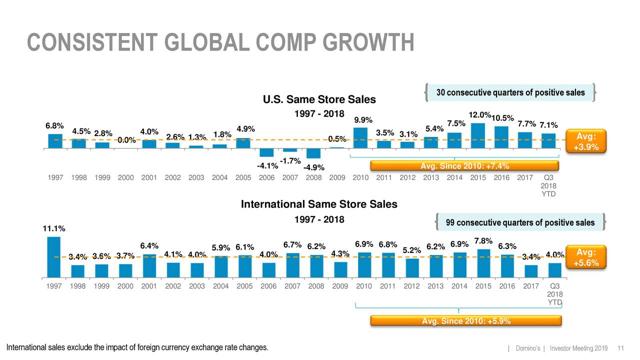
The graphic below shows the global growth of Domino's Pizza over the years with increasing sales almost every year as stated by the CEO.

The fourth quarter marked our 31st consecutive quarter of positive US same-store sales growth and capped very strong top-line performance in 2018, above our three to five-year outlook range. And continually driven by focus, fundamentals, and execution. I'm so proud of our US franchisees and teams who continue to lead the Domino's system."

Source: March 8, 2019, Investment Conference Slides

Takeaways

Domino's Pizza is a great investment choice for the total return investor with it's above DOW average total return and the dividend growth investor for income. Domino's Pizza will be considered for The Good Business Portfolio as an addition to the McDonalds (MCD) position since they sell different products. If you want a growing dividend income and great total return in the fast food business, DPZ may be the right investment for you.

Recent Portfolio Changes

I intend to watch the earnings reports for the companies in the portfolio and may finally decide to trim my high flyers that are over 8% of the portfolio so I can invest in good companies on my buy list.

On March 13 increased position of Realty Income Corp. (O) to 0.85% of the portfolio, I could use a bit more steady monthly income. On March 12 the portfolio closed out the position of Arconic (ARNC) , I only have one more commodity play Freeport McMoRan (FCX) that I think will go up over time. On March 11 the portfolio reduced the position of Arconic (ARNC) from 0.4% of the portfolio to 0.3%. I will sell the rest of this position within the month. The dividend was just cut, and forward growth is under-par. On March 7 added to position of Simulation Plus (SLP) from 0.33% of the portfolio to 0.45%. I will add slowly to this position as available cash allows. On March 4, trimmed position of Hewlett Packard (HPQ) from 1.3% of the portfolio to 1.0%. The last earnings report was poor, and future growth looks weak at 2%, time to sell HPQ for a better business. On February 28, trimmed position of Boeing (BA) from 16.1% of the portfolio to 15.8%. I love Boeing, but you have to have diversification. On February 2 increased position of Realty Income Corp. to 0.7% of the portfolio, I could use a bit more steady monthly income. On January 30 increased the position of Simulations Plus from 0.2% of the portfolio to 0.4%. I think their product may be the product of the future for drug testing. On January 28 Bought a starter position of Realty Income Corp., I could use a bit more steady income and hope to add to this holding in the future. Realty Income Corp. is now 0.4% of the portfolio. On January 28 sold the remaining portion of Mondelez (MDLZ). The forward growth does not look good enough. On January 24 increased the position of Digital Reality Investors (DLR) from 3.1% of the portfolio to 3.6%. I want to get DLR up to a full position of 4%. On January 16 sold the remaining shares of 3M (MMM). I decided to sell this small position in order to reduce the number of positions with a new target number of 20 positions max from 25. On January 11 started a new position in Lockheed (LMT) at 0.65% of the portfolio.

The Good Business Portfolio trims a position when it gets above 8% of the portfolio. The five top percentage of the portfolio companies in the portfolio are, Johnson & Johnson (JNJ) is 8.3% of the portfolio, Eaton Vance Enhanced Equity Income Fund II is 8.0% of the portfolio, Home Depot (HD) is 8.8% of the portfolio, Omega Health Investors (OHI) and Boeing (BA) is 14.8% of the portfolio. Therefore BA, EOS, JNJ, OHI, and Home Depot are now in trim position, but I am letting them run a bit since they are great companies.

Boeing is going to be pressed to 15% of the portfolio because of it being cash positive on 787 deferred plane costs at $316 Million in the first quarter of 2017, an increase from the fourth quarter. The first quarter earnings for 2018 were unbelievable at $3.64 compared too expected at $2.64. Farnborough Air Show sales in dollar value just beat out Air-Bus by about $6 Billion, and both companies had a great number of orders. Boeing received an order for 18 more KC-46A planes. The second quarter 2018 earnings beat expectations by $0.06 at $3.33, but a good report was hurt by a write off expense on the KC-46 which has started delivery in 2019. Two KC-46A tankers were delivered in January 2019. As a result of the good fourth-quarter earnings, S&P CFRA raised the one-year price target to $500 for a possible 20% upside potential. Boeing has dropped in the last 2 weeks because of the second 737 Max-8 crash, and I look at this as an opportunity to buy BA at a reasonable price. This is just my opinion.

JNJ will be pressed to 9% of the portfolio because of its defensive nature in this post-BREXIT world. Earnings in the last quarter beat on the top and bottom line and Mr. Market did nothing. JNJ has an estimated dividend increase to $0.97/Qtr. in April 2019, which will be 57 years in a row of increases. JNJ is not a trading stock but a hold forever; it is now a strong buy as the healthcare sector remains under pressure.

For the total Good Business Portfolio, please see my article on The Good Business Portfolio: 2018 4 th Quarter Earnings and Performance Review for the complete portfolio list and performance. Become a real-time follower, and you will get each quarter's performance after the next earnings season is over.

Disclosure: I am/we are long BA, JNJ, HD, OHI, MO, IR, DLR, GE, PM, IR, EOS, TXN, ADP, FCX, MCD, O. I wrote this article myself, and it expresses my own opinions. I am not receiving compensation for it (other than from Seeking Alpha). I have no business relationship with any company whose stock is mentioned in this article.

Additional disclosure: Of course, this is not a recommendation to buy or sell, and you should always do your own research and talk to your financial advisor before any purchase or sale. This is how I manage my IRA retirement account, and the opinions of the companies are my own.

Tuesday, March 19, 2019

Top 10 Penny Stocks To Buy Right Now

tags:BAMM,UBOH,SIRI,BDSI,FFNW,SMSI,SORL,UMH,TSN,AAWW,

After years of languishing in penny stock territory, shares of Calumet Specialty Products Partners (NASDAQ:CLMT) have had a nice run over the past year as its income statement is starting to show the results of management's turnaround program. This past quarter, the company's headline numbers didn't quite show the progress we have seen in prior ones, but there are still reasons to believe that things are picking up at this specialty chemical producer and oil refiner.

Let's take a look at Calumet's most recent quarter to see why the less-than-stellar headline numbers are covering up some rather impressive operating results and why investors may finally want to start looking at this stock again.  

By the numbers Metric Q1 2018 Q4 2017 Q1 2017 Revenue $750.5 million $883.8 million $886.5 million Adjusted EBITDA $75.0 million $60.1 million $78.7 million Net income ($4.8 million) ($64.9 million) ($6.2 million) Limited partners' interest in net income per share ($0.06) ($0.82) ($0.08) Distributable cash flow $23.0 million ($8.4 million) $31.5 million

Data sources: Calumet Specialty Products Partners earnings releases.

Top 10 Penny Stocks To Buy Right Now: Books-A-Million Inc.(BAMM)

Advisors' Opinion:
  • [By Joseph Griffin]

    News articles about Books-A-Million (NASDAQ:BAMM) have trended positive recently, according to Accern. The research group rates the sentiment of news coverage by monitoring more than 20 million blog and news sources. Accern ranks coverage of publicly-traded companies on a scale of negative one to one, with scores closest to one being the most favorable. Books-A-Million earned a coverage optimism score of 0.27 on Accern’s scale. Accern also gave news articles about the specialty retailer an impact score of 44.3915244007427 out of 100, meaning that recent news coverage is somewhat unlikely to have an impact on the stock’s share price in the immediate future.

Top 10 Penny Stocks To Buy Right Now: United Bancshares Inc.(UBOH)

Advisors' Opinion:
  • [By Logan Wallace]

    United Bancshares Inc. OH (NASDAQ:UBOH) and Bank of America (NYSE:BAC) are both finance companies, but which is the better investment? We will contrast the two businesses based on the strength of their valuation, dividends, earnings, risk, institutional ownership, profitability and analyst recommendations.

Top 10 Penny Stocks To Buy Right Now: Sirius XM Radio Inc.(SIRI)

Advisors' Opinion:
  • [By Rick Munarriz]

    A lot can happen to a stock in just a couple of weeks. There were 275.5 million shares of Sirius XM Holdings (NASDAQ:SIRI) sold short at the end of January, the largest number of bearish bets placed on the satellite radio provider in more than a year. Two weeks later, short interest fell to 174.7 million shares, a fresh 52-week low in pessimism. 

  • [By Rick Munarriz]

    We're now more than a year removed from when Sirius XM Radio (NASDAQ:SIRI) abandoned plans to buy Pandora outright, taking a minority stake instead. Now that streaming stocks in general and Pandora in particular are hot again, it wouldn't be a surprise if Sirius XM or any tech giant wanting an audience of more than 70 million streaming accounts snaps up Pandora. 

  • [By Motley Fool Staff]

    In this segment from Motley Fool Money, host Chris Hill asks analysts David Kretzmann, Seth Jayson, and Jason Moser to share the companies they have their eyes on this week, and why. Their picks are not entirely bullish: Of satellite radio provider Sirius XM (NASDAQ:SIRI), RV maker Thor Industries (NYSE:THO), and mailing and shipping solutions provider Stamps.com (NASDAQ:STMP), only two are recommendations. The third...well, listen in and find out.

  • [By Chris Hill]

    Lastly, the Fools answer a classic question from a listener: "When should an investor start taking profits on a multibagger stock? Or should he just hold on forever?" Since the answer to this depends a lot on the company, they both talk generally and address the case of the listener's stock -- Sirius XM (NASDAQ:SIRI) -- which is up around 500% since he bought it.

  • [By Steve Symington, Reuben Gregg Brewer, and Sean Williams]

    So, we asked three top Motley Fool contributors to each find a growth stock for the long term. Read on to learn why they like 2U (NASDAQ:TWOU), Sirius XM (NASDAQ:SIRI), and Eaton (NYSE:ETN).

  • [By ]

    Berkshire's biggest winners in the stock market so far this year are MasterCard Inc. (MA) , up 23%; Sirius XM Holdings Inc. (SIRI) , up 18%; Phillips 66 (PSX) , up 14%; Visa Inc. (V) , up 11%; and Moody's Corp. (MCO) , also up 11%, according to FactSet.

Top 10 Penny Stocks To Buy Right Now: BioDelivery Sciences International Inc.(BDSI)

Advisors' Opinion:
  • [By Joseph Griffin]

    BioDelivery Sciences International, Inc. (NASDAQ:BDSI) Director Francis E. Odonnell, Jr. sold 8,000 shares of the firm’s stock in a transaction on Friday, February 1st. The stock was sold at an average price of $4.60, for a total value of $36,800.00. The sale was disclosed in a document filed with the Securities & Exchange Commission, which can be accessed through this hyperlink.

  • [By Motley Fool Transcribers]

    Biodelivery Sciences International Inc  (NASDAQ:BDSI)Q4 2018 Earnings Conference CallMarch 14, 2019, 4:30 p.m. ET

    Contents: Prepared Remarks Questions and Answers Call Participants Prepared Remarks:

    Operator

  • [By Stephan Byrd]

    Media headlines about BioDelivery Sciences International (NASDAQ:BDSI) have been trending somewhat positive recently, according to Accern Sentiment. The research firm identifies positive and negative media coverage by reviewing more than 20 million blog and news sources in real-time. Accern ranks coverage of companies on a scale of negative one to one, with scores closest to one being the most favorable. BioDelivery Sciences International earned a news sentiment score of 0.16 on Accern’s scale. Accern also assigned media headlines about the specialty pharmaceutical company an impact score of 46.960149735727 out of 100, meaning that recent media coverage is somewhat unlikely to have an impact on the company’s share price in the next few days.

Top 10 Penny Stocks To Buy Right Now: First Financial Northwest Inc.(FFNW)

Advisors' Opinion:
  • [By Stephan Byrd]

    Get a free copy of the Zacks research report on First Financial Northwest (FFNW)

    For more information about research offerings from Zacks Investment Research, visit Zacks.com

  • [By Logan Wallace]

    Get a free copy of the Zacks research report on First Financial Northwest (FFNW)

    For more information about research offerings from Zacks Investment Research, visit Zacks.com

  • [By Max Byerly]

    First Financial Northwest (NASDAQ:FFNW) will be announcing its earnings results on Tuesday, July 24th. Analysts expect the company to announce earnings of $0.26 per share for the quarter.

  • [By Ethan Ryder]

    Get a free copy of the Zacks research report on First Financial Northwest (FFNW)

    For more information about research offerings from Zacks Investment Research, visit Zacks.com

Top 10 Penny Stocks To Buy Right Now: Smith Micro Software Inc.(SMSI)

Advisors' Opinion:
  • [By Shane Hupp]

    Okta (NASDAQ: OKTA) and Smith Micro Software (NASDAQ:SMSI) are both computer and technology companies, but which is the superior stock? We will compare the two businesses based on the strength of their earnings, analyst recommendations, institutional ownership, dividends, risk, valuation and profitability.

  • [By Ethan Ryder]

    Connecture (OTCMKTS: CNXR) and Smith Micro Software (NASDAQ:SMSI) are both small-cap computer and technology companies, but which is the superior investment? We will contrast the two businesses based on the strength of their risk, institutional ownership, profitability, dividends, valuation, analyst recommendations and earnings.

  • [By Stephan Byrd]

    These are some of the news stories that may have impacted Accern’s scoring:

    Get Smith Micro Software alerts: Short Interest in Smith Micro Software (SMSI) Increases By 51.9% (americanbankingnews.com) Smith Micro Software’s (SMSI) CEO Bill Smith on Q1 2018 Results – Earnings Call Transcript (seekingalpha.com) Smith Micro Software (SMSI) Reports Q1 Loss of $0.10 (streetinsider.com) Smith Micro Reports First Quarter 2018 Financial Results (finance.yahoo.com) Smith Micro announces above market USD 7.0m private placement offering (financial-news.co.uk)

    Separately, ValuEngine upgraded shares of Smith Micro Software from a “sell” rating to a “hold” rating in a report on Friday, February 2nd.

Top 10 Penny Stocks To Buy Right Now: SORL Auto Parts Inc.(SORL)

Advisors' Opinion:
  • [By Lisa Levin]

    SORL Auto Parts, Inc. (NASDAQ: SORL) is expected to report quarterly earnings at $0.19 per share on revenue of $86.96 million.

    Aldeyra Therapeutics, Inc. (NASDAQ: ALDX) is projected to report quarterly loss at $0.39 per share.

  • [By Max Byerly]

    These are some of the news articles that may have impacted Accern Sentiment Analysis’s analysis:

    Get Innovative Industrial Properties alerts: Return on Equity (ROE) under Consideration Innovative Industrial Properties, Inc. (NYSE:IIPR), Neonode Inc … (stocksnewspoint.com) Morning Miraculous Stocks: Taseko Mines Limited (NYSE:TGB), WMIH Corp. (NASDAQ:WMIH), Innovative Industrial … (journalfinance.net) Dazzling Stocks: Innovative Industrial Properties, Inc. (NYSE:IIPR), SORL Auto Parts, Inc. (NASDAQ:SORL), ReWalk … (thestreetpoint.com) Head-To-Head Contrast: Kennedy-Wilson (KW) vs. Innovative Industrial Properties (IIPR) (americanbankingnews.com) Innovative Industrial (IIPR) versus Colliers International Group (CIGI) Financial Contrast (americanbankingnews.com)

    A number of research analysts have weighed in on the company. Zacks Investment Research raised Innovative Industrial Properties from a “sell” rating to a “hold” rating in a report on Friday, March 16th. ValuEngine raised Innovative Industrial Properties from a “hold” rating to a “buy” rating in a report on Wednesday, May 2nd.

  • [By Lisa Levin] Gainers Euro Tech Holdings Company Limited (NASDAQ: CLWT) shares rose 14.1 percent to $3.65 in the pre-market trading session after reporting 2017 year-end results. LightPath Technologies, Inc. (NASDAQ: LPTH) rose 13.3 percent to $2.43 in pre-market trading after reporting a third-quarter earnings beat. MYnd Analytics, Inc. (NASDAQ: MYND) rose 10.5 percent to $3.49 in pre-market trading. MYnd Analytics reported a Q2 net loss of $2.7 million on revenue of $459,900. SORL Auto Parts, Inc. (NASDAQ: SORL) shares rose 8.4 percent to $5.68 in pre-market trading after reporting upbeat Q1 results. Famous Dave's of America, Inc. (NASDAQ: DAVE) shares rose 7.7 percent to $8.40 in pre-market trading after the company reported upbeat earnings for its first quarter on Monday. Xenon Pharmaceuticals Inc. (NASDAQ: XENE) rose 7.5 percent to $6.45 in pre-market trading after the company presented XEN901 Phase 1 clinical update and XEN1101 TMS pharmacodynamic Phase 1 data. Mimecast Ltd (NASDAQ: MIME) rose 6.5 percent to $43.50 in pre-market trading following a first-quarter sales beat. Boxlight Corporation (NASDAQ: BOXL) rose 6 percent to $12.50 in pre-market trading after surging 77.44 percent on Monday. Intellia Therapeutics, Inc. (NASDAQ: NTLA) shares rose 6 percent to $26.05 in pre-market trading after climbing 3.58 percent on Monday. PPDAI Group Inc. (NASDAQ: PPDF) rose 4.7 percent to $7.20 in pre-market trading following Q1 results. Xunlei Limited (NASDAQ: XNET) rose 4.1 percent to $13.88 in pre-market trading after gaining 2.54 percent on Monday. Valeant Pharmaceuticals International, Inc. (NYSE: VRX) shares rose 4.5 percent to $21.73 in pre-market trading. Mizuho upgraded Valeant from Neutral to Buy. Bovie Medical Corporation (NYSE: BVX) rose 4.1 percent to $3.80 in pre-market trading after reporting a first-quarter sales beat. Myomo, Inc. (NYSE: MYO) rose 3.4 percent to $4.00 in pre-market trading after jumping 23.25 percent o

Top 10 Penny Stocks To Buy Right Now: UMH Properties Inc.(UMH)

Advisors' Opinion:
  • [By Max Byerly]

    Get a free copy of the Zacks research report on UMH PROPERTIES/SH SH (UMH)

    For more information about research offerings from Zacks Investment Research, visit Zacks.com

  • [By Shane Hupp]

    TRADEMARK VIOLATION NOTICE: “Loeb Partners Corp Has $1.44 Million Holdings in UMH PROPERTIES/SH SH (UMH)” was first reported by Ticker Report and is the property of of Ticker Report. If you are viewing this article on another domain, it was stolen and reposted in violation of U.S. and international trademark and copyright laws. The correct version of this article can be viewed at https://www.tickerreport.com/banking-finance/4159809/loeb-partners-corp-has-1-44-million-holdings-in-umh-properties-sh-sh-umh.html.

  • [By Max Byerly]

    Get a free copy of the Zacks research report on UMH PROPERTIES/SH SH (UMH)

    For more information about research offerings from Zacks Investment Research, visit Zacks.com

  • [By Lisa Levin]

    Wednesday afternoon, the real estate shares surged 0.56 percent. Meanwhile, top gainers in the sector included Armada Hoffler Properties, Inc. (NYSE: AHH), up 3 percent, and UMH Properties, Inc. (NYSE: UMH) up 3 percent.

  • [By Logan Wallace]

    Get a free copy of the Zacks research report on UMH PROPERTIES/SH SH (UMH)

    For more information about research offerings from Zacks Investment Research, visit Zacks.com

  • [By Garrett Baldwin]

    Billions Are Now in Play: Millions of Americans could collect "federal rent checks" – to learn how to claim your portion of an $11.1 billion money pool using this backdoor investment, click here now…

    Shares of General Electric Co. (NYSE: GE) continue to slump. The stock was off another 1%, a day after falling another eight percentage points. The downturn came after its CEO announced its industrial division will be cash-flow negative in 2019. Shares of PepsiCo Inc. (NYSE: PEP) were off 1% this morning after the stock received a downgrade from Credit Suisse Group AG (NYSE: CS). While the Swiss bank called PepsiCo a "high quality" business, it raised concerns about its need to heavily invest over several years into struggling business lines and snack products. It also raised concerns about the ongoing competitive threats in the industry. CS set a price target for Pepsi at $100 per share, which is well below yesterday's trading price of $116. Look for other earnings reports from American Outdoor Brands Corp. (NASDAQ: AOBC), Burlington Stores Inc. (NASDAQ: BURL), Care.com Inc. (NASDAQ: CRCM), Chuy's Holdings Inc. (NASDAQ: CHUY), El Pollo Loco Holdings Inc. (NASDAQ: LOCO), GNC Holdings Inc. (NYSE: GNC), H&R Block Inc. (NYSE: HRB), Hovnanian Enterprises Inc. (NYSE: HOV), Plug Power Inc. (NASDAQ: PLUG), and UMH Properties SH (NYSE: UMH).

    Follow Money Morning on Facebook, Twitter, and LinkedIn.

Top 10 Penny Stocks To Buy Right Now: Tyson Foods Inc.(TSN)

Advisors' Opinion:
  • [By ]

    Tyson Foods (TSN) CEO Tom Hayes wasn't kidding when he told TheStreet he wanted to make another big acquisition soon. 

    But the argument could be made that Wall Street wasn't expecting his latest food purchase. On Tuesday, Tyson Foods said it will spend $850 million to buy the poultry rendering and blending assets of American Proteins, Inc. and AMPRO Products, Inc.

  • [By Garrett Baldwin]

    By submitting your email address you will receive a free subscription to Profit Alerts and occasional special offers from Money Map Press and our affiliates. You can unsubscribe at anytime and we encourage you to read more about our privacy policy.

    Shares of GoPro Inc. (NASDAQ: GPRO) added 2.2% after the company reported earnings after the bell and said that it is on a path to profitability. However, to get into the black, the firm had to cut several hundred employees to keep operating expenses below $400 million. Shares of Chipotle Mexican Grill Inc. (NYSE: CMG) popped more than 10% after the company blew out earnings expectations after the bell yesterday. The company's ongoing turnaround has produced a big uptick in consumer foot traffic. The firm reported EPS of $1.72, well above the $1.37 per share. Revenue came in at $1.23 billion and topped expectations, as did same-store growth at 6.1%. Look for other earnings reports from ANGI HomeServices Inc. (NASDAQ: ANGI), ArcelorMittal SA (NYSE: MT), Cardinal Health Inc. (NYSE: CAH), Dunkin' Brands Group Inc. (NASDAQ: DNKN), Expedia Group Inc. (NASDAQ: EXPE), GrubHub Inc. (NASDAQ: GRUB), IAC/InterActiveCorp. (NYSE: IAC), Kellogg Co. (NYSE: K), Macerich Co. (NYSE: MAC), Mattel Inc. (NYSE: MAT), News Corp. (NASDAQ: NWSA), Penn National Gaming Inc. (NASDAQ: PENN), Sanofi SA (NYSE: SNY), Tyson Foods Inc. (NYSE: TSN), World Wrestling Entertainment Inc. (NYSE: WWE), and Yum! Brands Inc. (NYSE: YUM). These 3 Stocks Are the Key to 2019's Greatest Profits

    The 2018 midterm election was a turning point for the cannabis industry.

  • [By ]

    Cramer said he'll be listening to Tyson Foods (TSN) on Monday, but with rising input costs, the bears are likely to keep winning in the short-term. On a positive note, Service Now (NOW) will be holding an analyst day, which will be sure to ignite the cloud stocks.

  • [By Lisa Levin]

    Tyson Foods, Inc. (NYSE: TSN) reported weaker-than-expected results for its fiscal second quarter.

    Tyson posted quarterly earnings of $1.271 per share on sales of $9.773 billion. Analysts expected earnings of $1.32 per share on sales of $9.89 billion. Tyson expects FY18 earnings of $6.55 to $6.70 per share.

Top 10 Penny Stocks To Buy Right Now: Atlas Air Worldwide Holdings(AAWW)

Advisors' Opinion:
  • [By Motley Fool Transcribing]

    Atlas Air Worldwide Holdings (NASDAQ:AAWW) Q4 2018 Earnings Conference CallFeb. 19, 2019 11:00 a.m. ET

    Contents: Prepared Remarks Questions and Answers Call Participants Prepared Remarks:

    Operator

  • [By Logan Wallace]

    Get a free copy of the Zacks research report on Atlas Air Worldwide (AAWW)

    For more information about research offerings from Zacks Investment Research, visit Zacks.com

  • [By Max Byerly]

    James Investment Research Inc. grew its position in shares of Atlas Air Worldwide Holdings, Inc. (NASDAQ:AAWW) by 124.4% during the 2nd quarter, Holdings Channel reports. The firm owned 58,875 shares of the transportation company’s stock after purchasing an additional 32,635 shares during the quarter. James Investment Research Inc.’s holdings in Atlas Air Worldwide were worth $4,221,000 at the end of the most recent quarter.

  • [By Max Byerly]

    Atlas Air Worldwide (NASDAQ:AAWW) was downgraded by stock analysts at BidaskClub from a “sell” rating to a “strong sell” rating in a research report issued on Wednesday.

  • [By Logan Wallace]

    BidaskClub upgraded shares of Atlas Air Worldwide (NASDAQ:AAWW) from a sell rating to a hold rating in a research note issued to investors on Tuesday morning.

Friday, March 15, 2019

Startek, Inc. (SRT) Q4 2018 Earnings Conference Call Transcript

Logo of jester cap with thought bubble with words 'Fool Transcripts' below it

Image source: The Motley Fool.

StarTek, Inc. (NYSE:SRT) Q4 2018 Earnings Conference Call March 13, 2019 5:00 p.m. ET

Contents: Prepared Remarks Questions and Answers Call Participants Prepared Remarks:

Operator

Good afternoon, everyone, and thank you for participating in today's conference call to discuss StarTek's financial results for the quarter ended December 31, 2018. Joining us today is StarTek's President and Global CEO, Lance Rosenzweig, and the company's CFO, Ramesh Kamath.

Following their remarks, we'll open the call for your questions. Before we continue, we would like to remind all participants that the discussion today may contain certain statements which are forward-looking in nature pursuant to the safe harbor provisions of the federal security laws. These statements are subject to various risks and uncertainties, and actual results may vary materially from these projections. StarTek advises all those listening to this call today to review the latest 10-Q and 10-K posted on their website for a summary of these risks and uncertainties. StarTek does not undertake the responsibility to update these projections.

Further, the discussion today may include some non-GAAP measures. In accordance with Regulation G, the company has reconciled these amounts back to the closest GAAP-based measurements. The reconciliations can be found in the earnings release on the Investors section of their website. I would now like to remind everyone that a webcast replay of today's call will be available via the Investors section of the company's website at www.startek.com.

Now I would like to turn the call over to StarTek's President and Global CEO, Lance Rosenzweig. Sir, please proceed.

Lance Rosenzweig -- President and Global Chief Executive Officer 

Thank you, Sonia. Good afternoon everyone and thank you all for joining. The StarTek and Aegis integration is largely complete and led to a very strong quarter of operational performance and business development. Our post-merger integration team also continued to identify and implement both revenue and cost synergies across the organization.

Operationally, StarTek grew revenue and adjusted EBITDA sequentially due to improved client diversification and strong growth from our non-telecom verticals. For the second quarter in a row, excluding telco, we grew revenue with every one of our top 10 clients with some clients even accelerating grow from last quarter. Further, we experienced some of the strongest holiday volumes ever seen by the company as we now have a great mix of next-gen retail clients.

A good portion of our growth in Q4 was driven by a shift in operational structure. During the quarter, we implemented a new client-centric model in the Americas to replace our previous geographic model. To summarize, historically, StarTek followed the old-fashioned call center industry geographic based organization where center heads report to regional heads who report to country heads, etcetera. In this model, if a client was utilizing our services in multiple geographies, each operating team would report to a different regional leader. This resulted in an inconsistent performance with no single point of responsibility. Now, in our next generation client-centric model, client teams in all campuses report to a single client leader that manages that client relationship.

Under this new model, we are able to better understand, and address client needs consistently and globally while deploying services in the most appropriate geographies to enhance performance and utilization. After implementing this new structure, the benefits to both our clients and to StarTek was immediately evident. Our performance was up. Our clients were happier. And we were rewarded with more business and an increasing number of campuses delivering services.

Given the strong reception from our clients in the Americas. We have recently begun to roll out this new model with the rest of our global client base which we expect will benefit both revenue and margins going forward.

From a business development perspective, we continue to see accelerating demand for our new geographic footprint and service capabilities. Due to this growing demand and strong client growth, during the fourth quarter, StarTek added to our capacity with the opening of a new campus in Tegucigalpa, Honduras. This is now our third delivery campus in Honduras and the grand opening was quite the event. We were greeted by Honduras president, Juan Olando Hernandez, senior government officials, and many community partners during a celebration that included presentations and a ceremonial ribbon cutting to mark the opening of the new facility. In 2011, StarTek became one the first BPO companies to launch a delivery campus in Honduras and today we are one of the largest outsourced customer care providers in the entire country with more than 22,000 customer experienced experts.

Touching a bit further on our global presence, I believe an important aspect of our company that is often overlooked is the unique culture and support we can bring to other countries around the world. For example, in Saudi Arabia, our 51% owned joint venture is currently the largest employer of women in the entire country. I recently visited our team in Riyadh and was extremely impressed with the passion, leadership, and excellent performance of the team for clients in the region.

Globally, StarTek is exhibiting strong leadership in diversity and inclusion. In particular, employing and supporting persons with disabilities. We were proud to be recognized by the Society for Human Resource Management for excellence in diversity and inclusion. It was a great honor to meet with some of our award-winning disabled team members in Gurgaon, India who are delivering excellence for our clients every day and whose accomplishment in the face of adversity serve as an inspiration to our entire company. I am proud of the opportunities and benefits we are bringing to the individuals and countries in which we operate.

I am also happy to report that subsequent to year end, we strengthened our board of directors with the appointments of Julie Schoenfeld and Albert Aboody. Each of these new directors brings unique and relevant skill sets to our board and we look forward to leveraging their experience and knowledge as we capitalize on the many growth opportunities ahead. I would like to thank Ben Rosenzweig and Robert Sheft for their contributions to the board over the last several years. We wish them the best going forward.

Before wrapping up with my closing remarks, I'd like to turn the call over to our Chief Financial Officer, Ramesh Kamath, to take you through StarTek's financial results. Ramesh.

Ramesh Kamath -- Chief Financial Officer

Thank you, Lance. The quarter results we are reporting today include StarTek and Aegis financials from October 1 through December 31, our first time reporting a full quarter. As mentioned on our last quarterly call, the business combination resulted in a change in fiscal year end from December 31st to March 31st which is the fiscal year end for Aegis. However, in October, the StarTek board of directors voted to change the fiscal year end back to December 31. As a result, we will be filing a transitional report on form 10-KT for the nine months ending December 31, 2018.

Due to certain limitations in regard to publically available financial information, we are unable to provide the combined company financials from the year over period. As a result, we will not discuss year on year comparisons as we would be comparing the financials of two companies against one. Instead, we believe it will be more effective to highlight the quarter over quarter results with qualitative commentary about the general trends and drivers for each major line item.

As noted in our press release today, the comparative results for the quarter ending September 30th included StarTek results from July 20th through September 30th combined with Aegis results for the full quarter July 1st through September 30th, 2018.

Now, having said that, total revenue for the fourth quarter of 2018 increased 5% to $158.6 million compared to $151.5 million in the quarter ending September 30th. We continue to face headwinds in our telecom vertical. However, it is having less of a profit impact on our overall business due to strong growth from our non-telecom clients. Our non-telecom growth has been driven by excellent client expansion programs and new client wins including the finding of a large retail client during the last quarter.

As Lance mentioned, we also experienced higher volume related to holiday seasonality, which reflects the ongoing diversification of our client base as we now have a greater mix of next-gen retail clients.

Gross profit for the quarter increased 10% to $25.1 million compared to $22.8 million with gross margins of 15.8% compared to 15% in the quarter ending September. Margins continue to improve primarily due to the cost savings associated with synergies from the business combination along with higher volumes related to the holiday season.

SG&A for the quarter was $21.9 million as compared to $22.8 million in the quarter ending September. As a percentage of revenue, SG&A was 13.8% as compared to 15.1%.

Net loss for the quarter was $9.7 million or a negative $0.26 per share compared to a loss of $10.9 million or $0.32 per share negative in the quarter ending September 30th. Note that although this loss is lower than the previous quarter, it's higher than what we would expect on a normalized basis due to transaction-related and restructuring costs incurred in the quarter. In addition, we were not able to recognize the tax benefit for losses and certain benefits which led to a higher tax provision for this quarter.

Adjusted EBITDA for the quarter increased 40% to $11.4 million compared to $8.1 million in the quarter ending September 30th. As a percentage of revenue, adjusted EBITDA was 7.2% compared to 5.4%.

From a cost synergy perspective, we completed additional actions during the quarter to bring our total reduction in annualized cost to over $16 million since completing the merger. We are well on track to deliver on our previously stated goal of realizing $30 million in adjusted EBITDA from synergies, revenue growth, and operating efficiencies by mid-2021.

From a balance sheet perspective as of December 31, we are approximately $24.6 million of cash and approximately $185.7 million of gross debt. This compares with $20.5 million of cash and $178.3 million of gross debt at September 30th.

In 2019, we expect to reduce our net debt position and spend on the balance sheet while also utilizing our free cash to deploy across various investments to our technology infrastructure.

This concludes my prepared remarks. I will now turn over the call back to Lance. Lance?

Lance Rosenzweig -- President and Global Chief Executive Officer 

Thank you, Ramesh. Overall, I am very proud of the progress our team has made to return StarTek to higher growth and margin expansion. We are truly gaining momentum with our new global footprint and capabilities as we implement best practices and operational excellence throughout the company.

Looking ahead, we will continue to identify opportunities for revenue growth and operating efficiencies while focusing our business development efforts in high-growth verticals such as technology, financial services, next-gen retail, healthcare, and travel. We are well positioned to execute on our growth initiatives and look forward to carrying this momentum through 2019.

Operator, Ramesh and I will now open up the call for questions.

Questions and Answers:

Operator

Thank you. Ladies and gentlemen, if you would like to ask a question at this time, please press * then 1 on your touchtone telephone. If your question has been answered or you wish to remove yourself from the queue, please press the # key. To prevent any background noise, we ask that you please place your line on mute once your question has been stated.

Our first question comes from Dave Konig of Baird. Your line is now open.

Dave Konig -- Baird -- Analyst

Yeah. Hey, guys. Thank you and congrats on the retail clients. That sounds like good momentum there.

Lance Rosenzweig -- President and Global Chief Executive Officer 

Thank you, Dave.

Dave Konig -- Baird -- Analyst

Yeah. And I guess my first question, so the $158 million kind of base. At the first quarter, we have a kind of clean combined company base. Is that a good place to kind of as a starting point think of next year just using that $158 million as kind of your baseline quarterly result? From there, how is this seasonality going to work? Is Q1 a little lower than that and the rest of the quarters are a little above and maybe average the $158 million for the year? How should we think of that?

Lance Rosenzweig -- President and Global Chief Executive Officer 

Yeah. So, we're not, as we've mentioned in the past, providing forward-looking guidance. But I would say that this is our first full and clean quarter. There is a bit of seasonality in it as is typical in our industry with companies who have some seasonal clients. So, you're likely to see that seasonal trend will continue to the extent that we have this kind of retail business going forward.

Dave Konig -- Baird -- Analyst

Okay. Thank you. Secondly, you called out that the loss should be less going forward just simply because you had the restructuring type stuff in Q4. Are the other line items more normalized? There was nothing kind of one-off in some of the other line items like the gross margin and the SG&A?

Ramesh Kamath -- Chief Financial Officer

Hi, David, this is Ramesh. No, David. No other one-off items anywhere else. It's all par for the course.

Dave Konig -- Baird -- Analyst

Okay. Got you. And then, a couple of just housekeeping ones. I know Argentina the peso has been weak. Is there any way to think about how that impacted Q4 and maybe even how that impacts 2019?

Ramesh Kamath -- Chief Financial Officer

Everybody asks me about the Argentina peso and the good news is it has remained completely stable all over the last quarter for us. In our previous quarter, the value had depreciated by 50% in just one quarter, but quarter four has remained completely stable and as of today also for most of the first quarter it has remained stable. So, we are remaining reasonably hopeful that the worst is behind them. As I said, the reelection is in May. We'll know after that.

Dave Konig -- Baird -- Analyst

Got you. One last quick one. Free cash flow for '19, I would imagine your capex spending is going to probably be semi-low relative to D&A. Do you expect to have a free cash flow positive year in '19?

Ramesh Kamath -- Chief Financial Officer

As Lance keeps telling me all the time, we do not provide forward-looking guidance. So, you'll have to excuse us. But we have mentioned in our prepared speech that we are looking at investing in our retail technology and infrastructure assets.

Dave Konig -- Baird -- Analyst

Okay. Great. Thank you.

Lance Rosenzweig -- President and Global Chief Executive Officer 

Thanks, David.

Operator

Thank you. And our next question comes from analyst Omar Samalot. Your line is now open.

Omar Samalot -- Analyst

Thank you. Hello, guys.

Lance Rosenzweig -- President and Global Chief Executive Officer 

Hey, Omar.

Ramesh Kamath -- Chief Financial Officer

Hey, Omar.

Omar Samalot -- Analyst

I was pleased to see an improvement quarter over quarter and EBITDA improvement despite the lighter revenue. I guess it must mean that the market business continues to increase. How do you see the revenue picture evolving?

Lance Rosenzweig -- President and Global Chief Executive Officer 

As we mentioned in our remarks, we're continuing to see good growth from our client mix outside of telecom and moderating headwinds on the client mix within telecom. And that varies globally depending on the region of the world in which we are operating. So, we feel good about that. We're very happy with both the existing client performance and growth as well as the building pipeline by our sales team. So, we're feeling good.

Omar Samalot -- Analyst

Okay. Are you guys in a position yet to disclose utilization rates by segment for example? You're touting business wins, but we have no real idea in terms of concrete numbers. I was wondering if you were at a point where you can disclose some of that?

Lance Rosenzweig -- President and Global Chief Executive Officer 

We at this stage have not disclosed utilization rates in any kind of segmented way, but we are highly focused on it. And we see opportunities in certain parts of the world to better grow into our capacity and in other parts of the world, like Honduras, we needed new capacity and we launched it. And so, new capacity is clearly only a function of growth and outside of that better capacity utilization does drive better margins in a particular region.

Omar Samalot -- Analyst

Okay. And what in terms of these business wins?

Lance Rosenzweig -- President and Global Chief Executive Officer 

So, we are not commenting on specific new business wins, but I would say that the global sales reorganization that we've done, which enables us to focus on global clients as opposed to just in region clients, is generating a strengthening pipeline by a very strong and active sales team. So, I'm actually quite excited about the opportunities ahead in sales and client development.

Omar Samalot -- Analyst

Okay. And I'm assuming that given Ramesh's last answer, you are not providing a capex budget at this point yet?

Lance Rosenzweig -- President and Global Chief Executive Officer 

Correct. We are not providing forward-looking guidance. That's both in operating performance as well as capex.

Omar Samalot -- Analyst

Okay. I see a pretty nice draw up in the trade accounts receivable quarter over quarter. I was wondering, Ramesh, if you can comment on your DSOs for the quarter?

Ramesh Kamath -- Chief Financial Officer

Okay. My DSOs for the quarter should be in the range of about, let me give you a number, close to between 66 and 68 on bill receivables. And the last time, Omar, we spoke I must correct something. When I told you the DSO, I included the unbilled also which it looked higher but was not giving a good picture. So, if you were to do that comparison then you could say knock off about 13 to 15 less from what I told last time. And that will give you a proper comparative.

While DSOs have come down, I think please remember it is a holiday season in the US and collections in the last two weeks of December generally tends to be slow and it has picked up in the first of January. It's routine in this industry.

Omar Samalot -- Analyst

Okay. Got it. Okay. I also noticed that the provision for doubtful accounts increased to $2.2 million from $1.7 million quarter over quarter. Can you explain what's going on there?

Ramesh Kamath -- Chief Financial Officer

Yes. What we have done is we have, like we mentioned last time on our policy basis, we have been reviewing each of our accounts. During this account, we have done this provision to clean up all the financials. We don't expect such large numbers going forward. There has been a full scope audit done and we made sure that it's all cleaned up. Again, Omar, like I mentioned last time, in our case the provision is on a conservative basis. From the previous quarter's provisions, we actually collected $300 thousand already. So, I'm hoping that the next quarter will be a good quarter.

Omar Samalot -- Analyst

Got it. Okay. And I guess whatever collections you would be able to make would go straight to the bottom line?

Ramesh Kamath -- Chief Financial Officer

Correct.

Omar Samalot -- Analyst

Okay. In terms of the income taxes, they came in a bit higher than what I expected. I don't know if you can offer some color there and how you see that going forward and was a large part of that cash or non-cash?

Ramesh Kamath -- Chief Financial Officer

Most of the increase is non-cash. It's a deferred tax plan which we created. This arose from a discussion from our auditors where we took a very conservative stand. In one case we have a deferred tax asset. We said that the probability of the entire recovery in the near future may not be good. Personally, I am optimistic it will be, but the auditor said let's take it safe. In another case, accounting standards have changed. We decided to make a deferred tax provision for the first time, a liability actually.

So, yes. This is non-cash and you're not likely to see this lumpiness going forward.

Omar Samalot -- Analyst

Perfect. Okay. That's very helpful. All right. Some of your competitors have mentioned their ability to reprise North American based programs given the tight labor market. How are you guys doing in that area?

Lance Rosenzweig -- President and Global Chief Executive Officer 

It varies on a program by program basis and on a region by region basis. Overall, you did see margin expansion over the quarter in terms of gross margins. So, we're not seeing, for example, that rising labor rates are having a negative impact on our gross margins.

Omar Samalot -- Analyst

Okay. The Aegis side brought pretty important AI capabilities to the merger. I was wondering if you could talk about how though capabilities fit into your overall strategy?

Lance Rosenzweig -- President and Global Chief Executive Officer 

Long-term we're very excited about the opportunities that our digital offerings will have in the marketplace. It takes a while for these to productize, for clients to test them, for them to actually have a material impact on the financials. But we just have a great team of developers that are working on these products. We are also looking at partners who have excellent third-party products and then looking to kind of create integrated offerings for our clients.

I would say where we also are seeing great success is in our Ideal Dialogue offering. Ideal Dialogue is a proprietary product that we have here at StarTek, and we are rolling out that offering globally across our other operations and there is quite a bit of interest outside of the US. I think that we're going to see some nice opportunities for Ideal Dialogue going forward.

Omar Samalot -- Analyst

Okay. Cool. All right. In the past, you mentioned how Australia presents a great opportunity given your Philippines and Malaysian footprints allowing for almost around the clock utilization for those seats given their different time zones. I know you guys have been working to build that sales pipeline and recently I saw that you attended that Global Business Week in Sydney, I think it was last month. I was wondering if you could share any progress at all in that initiative?

Lance Rosenzweig -- President and Global Chief Executive Officer 

I don't know how you're getting my plane records. But I was in Australia a few weeks ago and our operations are actually in Melbourne. I'm quite upbeat about our opportunities there. I think we've got a great team. We've got some great clients with whom I met and I'm enthusiastic about our opportunities in Australia.

I will say that in our industry there is a sale cycle and it does take time. And so, as we talk about and look at new client opportunities, the sale cycle takes a bit of time. There is a lot of diligence that clients do. So, there's no immediate impact, but I think longer-term I'm feeling good about that part of the world.

Omar Samalot -- Analyst

Okay. Good. Excellent. Finally, I see the largest shareholder bought some more stock in December. I think it's a great confident signal. I was wondering if there is anything you can comment in terms of their thinking behind the transaction?

Lance Rosenzweig -- President and Global Chief Executive Officer 

Your question was a bit garbled, Omar. Are you talking about the CSP investment?

Omar Samalot -- Analyst

I saw that the largest shareholder in December bought some stock through a private transaction. So, I took that as a good confident signal. I was wondering if there was any comment that you could make on their thinking behind the transaction?

Ramesh Kamath -- Chief Financial Officer

I don't think we really have a comment around anyone buying our shares. On a very personal note, as long as they keep buying and not selling, I'm always a happy person.

Omar Samalot -- Analyst

Okay. Fair enough. Fair enough. Well, guys, thank you very much and I hope to see continued improvement going forward.

Lance Rosenzweig -- President and Global Chief Executive Officer 

Thank you, Omar.

Operator

Thank you. And again, ladies and gentlemen, if you would like to ask a question at this time, please press * then 1 on your touchtone telephone. And our next question comes from Dave Konig of Baird. Your line is now open.

Dave Konig -- Baird -- Analyst

Hey, guys. Just a couple of quick ones on the financials. What would the share count have been if profitable? I know you have 37.2 million shares. You don't have the options into the share cup, but what would the diluted share cup be if you were profitable?

Ramesh Kamath -- Chief Financial Officer

We don't have.

Lance Rosenzweig -- President and Global Chief Executive Officer 

Yeah. We don't have that number. We can try to get back to you on that one, David.

Dave Konig -- Baird -- Analyst

Yeah. No problem at all. The only other one is the interest expense that was close to $4 million. Is that a normalized number, nothing in there that's kind of one-off? Just so we know if there is something to take out in future quarters.

Ramesh Kamath -- Chief Financial Officer

No. This is a normalized number now.

Dave Konig -- Baird -- Analyst

Okay. Perfect. That's all I've got. Thank you for that.

Lance Rosenzweig -- President and Global Chief Executive Officer 

Okay. Thanks, David.

Operator

Thank you. Ladies and gentlemen, this does conclude our question and answer session. I would now like to turn the call back over to Mr. Rosenzweig. Please, proceed.

Lance Rosenzweig -- President and Global Chief Executive Officer 

Thank you, Sonia, and thank you all for joining us this afternoon and for your continued support of StarTek. We are always happy to make ourselves available to our shareholders and prospective investors by phone and encourage you to reach out. We look forward to speaking to you next quarter when we report our results in May. Thank you very much.

Operator

Thank you. Ladies and gentlemen, you may now disconnect.

Duration: 30 minutes

Call participants:

Lance Rosenzweig -- President and Global Chief Executive Officer 

Ramesh Kamath -- Chief Financial Officer

Dave Konig -- Baird -- Analyst

Omar Samalot -- Analyst

More SRT analysis

This article is a transcript of this conference call produced for The Motley Fool. While we strive for our Foolish Best, there may be errors, omissions, or inaccuracies in this transcript. As with all our articles, The Motley Fool does not assume any responsibility for your use of this content, and we strongly encourage you to do your own research, including listening to the call yourself and reading the company's SEC filings. Please see our Terms and Conditions for additional details, including our Obligatory Capitalized Disclaimers of Liability.

10 stocks we like better than StarTekWhen investing geniuses David and Tom Gardner have a stock tip, it can pay to listen. After all, the newsletter they have run for over a decade, Motley Fool Stock Advisor, has quadrupled the market.*

David and Tom just revealed what they believe are the ten best stocks for investors to buy right now... and StarTek wasn't one of them! That's right -- they think these 10 stocks are even better buys.

See the 10 stocks

*Stock Advisor returns as of March 1, 2019

3 Dividend Aristocrats to Buy and Hold Forever

Dividend Aristocrats -- or companies that have raised their dividends for a minimum of 25 consecutive years -- are always worth considering as long-term investing vehicles. These elite income stocks, after all, have trounced the performance of the broader markets for nearly 30 straight years at this point.

We thus asked three of our Motley Fool contributors which Dividend Aristocrats they would choose to buy and hold for basically forever. They choose AbbVie (NYSE:ABBV), PepsiCo (NASDAQ:PEP), and McDonald's (NYSE:MCD). Here's why.

A crown sitting on a purple drape

Image source: Getty Images.

A perfect buying opportunity

George Budwell (AbbVie): AbbVie, an Illinois-based drugmaker, is a Dividend Aristocrat by virtue of its former parent company, Abbott Laboratories. Even so, this top biopharma has done a lot to earn this coveted label on its own. Since going public in 2013, for instance, AbbVie has raised its dividend by an astounding 168% -- among the fastest within the large-cap biopharma space. 

Despite its top-notch dividend growth rate and its industry-leading levels of revenue growth over the past five years, AbbVie's stock has fallen out of favor with investors in 2019. AbbVie's shares have dropped by over 14% during just the first two and a half months of 2019. The long and short of it is that investors simply aren't buying that the company is capable of replacing Humira's revenue stream once the drug loses patent protection in the United States starting in 2023. 

Why? Well, AbbVie did experience a significant setback with the clinical failure of its cancer treatment Rova-T last year. However, this dire outlook arguably isn't warranted, even after this major clinical flop. AbbVie still has five other promising drugs that should comfortably offset any future dip in revenue stemming from Humira's loss of exclusivity.

Specifically, the company's cancer franchise is growing by leaps and bounds due to the breakout success of both Imbruvica and Venclexta; its new endometriosis drug called Orilissa is expected to ramp up slowly, but eventually achieve blockbuster status within the next decade; its hepatitis C medicine, Mavyret, should remain a stable source of revenue for at least another eight years; and the drugmaker's two high-value immunology assets -- risankizumab and upadacitinib -- should both gain key regulatory approvals later this year.   

Stated simply, AbbVie should have little trouble maintaining its elite dividend program for the long term thanks to its well-rounded product portfolio and top-shelf clinical pipeline. 

A sturdy beverage and snack giant

Keith Noonan (PepsiCo): A lot of the talk around PepsiCo and the beverage industry as a whole in recent years has revolved around the decline of soda. That might raise concerns about PepsiCo's ability to continue thriving and returning cash to shareholders if the business depended too heavily on sugary drinks. However, the company is actually pretty well diversified, and it enjoys substantial scale and infrastructure advantages that should help it continue delivering a solid performance.

Pepsi's North American beverage segment accounted for roughly 32.5% of the company's revenue in 2018, with its Frito-Lay and Quaker brands filling out its product offerings, and sales in non-domestic markets completing the sales picture. The company's Frito-Lay Snack division in particular has helped to deliver solid performance even as the fizz in domestic soda sales has gone worse than flat, allowing Pepsi to post 4% organic revenue growth in 2018. 

While the domestic soda slowdown has hurt performance, the shift in the market has not been abrupt or dramatic in a way that's caught Pepsi flat-footed, and it gives the company a reasonable timeline to continue modifying its beverage portfolio to better cater to market tastes. The beverage giant has already made significant progress on that front, and thankfully, the soda headwinds aren't affecting all geographic segments. With an international distribution imprint that has the distinction of being both incredibly impressive in scale and still open for growth, PepsiCo has long-term opportunities as it steadily expands and takes advantage of new operating efficiencies.

Pepsi yields roughly 3.2% and has raised its dividend on an annual basis for 47 years running. With the business looking strong and the cost of covering its current forward distribution coming in at a reasonable payout of 60% of trailing free cash flow, investors can continue to rely on the stock for steady payout growth for decades to come. 

The fast-food king

Jeremy Bowman (McDonald's): One Dividend Aristocrat I'd feel comfortable holding forever is McDonald's. The global fast-food leader has consistently delivered strong returns for investors, and it has raised its dividend every year for 43 years straight. Today, it offers a dividend yield of 2.6%, and it last raised its quarterly payout by 15% to $1.16 in Sept. 2018. Considering the company's reasonable payout ratio at 61.5%, investors should expect continuing dividend increases, though they won't be as high as 15% every year. 

Like many Dividend Aristocrats, McDonald's is a great choice for investors looking for defensive stocks, or investments that are resilient during a recession or a market downturn. As a fast-food restaurant chain offering cheap, convenient foods in places like city centers, interstate exits, malls, and airports, McDonald's business is relatively stable regardless of the overall health of the economy or consumer spending.

The company's franchise model further protects it from the vicissitudes of the economy as it is not directly responsible for things like labor costs at most of its restaurants. Like any industry, fast food is evolving with the influence of fast-casual chains like Chipotle and the popularity of delivery, but McDonald's is pivoting with it, remodeling restaurants in a program it calls Experience of the Future and partnering with UberEats on delivery.  

While the intricacies of the fast-food industry may change over time, the need for people to get fast, cheap, convenient food where they are is lasting, and no company has built a stronger position to meet that demand than McDonald's. 

Thursday, March 14, 2019

Oil-Dri Corp of America (ODC) Q2 2019 Earnings Conference Call Transcript

Logo of jester cap with thought bubble with words 'Fool Transcripts' below it

Image source: The Motley Fool.

Oil-Dri Corp of America (NYSE:ODC) Q2 2019 Earnings Conference CallMarch 11, 2019 4:30 p.m. ET

Contents: Prepared Remarks Questions and Answers Call Participants Prepared Remarks:

Operator

Good day, ladies and gentlemen, and welcome to the Q2 2019 Oil-Dri Corporation of America earnings conference call. [Operator instructions] I would now like to turn the call over to Dan Jaffee, president and CEO. Sir, please begin.

Dan Jaffee -- President and Chief Executive Officer

All right, Mark. Thank you, and welcome, everyone, to the second-quarter and six-month fiscal 2019 industrial teleconference. With me in the conference room here in Chicago is Mike McPherson, our chief development officer; Susan Kreh, our chief financial officer; Laura Scheland, our general counsel; Leslie Garber, who will be taking over the reins to be our director of investor relations. And last, but not least, and a big round of applause, this is Reagan's last meeting as our director of investor relations.

She got paroled for good behavior. She's been promoted to focus exclusively on marketing. So Reagan, thank you for everything. And please, take us through the safe harbor.

Reagan Culbertson -- Director of Investor Relations

Thanks, Dan. On today's call, comments may contain forward-looking statements regarding the company's performance in future periods. Actual results on those periods may materially differ. In our press release and our SEC filings, we highlight a number of important risk factors, trends and uncertainties that may affect our future performance.

We ask that you review and consider those factors in evaluating the company's comments and in evaluating any investment in Oil-Dri stock.

Dan Jaffee -- President and Chief Executive Officer

Thank you. And at this time, I'd like to call in Susan to walk us through the quarter and the six months.

Susan Kreh -- Chief Financial Officer

Sure, love to. Today, Oil-Dri reported sales of $69.9 million from second quarter of fiscal '19, which was a 1% increase over the second quarter of fiscal '18. Sales in our retail and wholesale products group were up 5% in quarter, driven by growth in cat litter, where we are experiencing strong demand in our lightweight private label products. Our Business to Business Product Group continue to see weakness in the quarter, with sales down 3% compared to the second quarter of fiscal '18, as performance of our Fluids Purification products were down internationally due to price competition by local suppliers.

We also experienced the continuation of the first-quarter reductions in our Amlan business in Asia, driven by the widespread impact of the African Swine Flu. While we do not expect an immediate turnaround in the swine industry in Asia, we do expect to see some recovery in the back half of the year as we continue to work with our customers on the trials and adoption of products such as Varium for poultries and NeoPrime for piglets to improve feed efficiency around the world. We also reported sales of $136 million for the first six months of the fiscal year, which was flat from the same period last year. Our Retail and Wholesale Product Group reported sales that were up 4% over the prior year, and again, driven by the strong performance in cat litter.

Our Business to Business Products Group reported sales that were down 5% for the first six months, primarily for the same reasons that I talked about in the quarter. Our second-quarter net income attributable to Oil-Dri was $2.3 million, compared to a loss of $1.1 million in the second quarter a year ago. For purposes of comparability, I'll point out that during the second quarter of fiscal '18, we incurred a one-time tax expense of $5.1 million, resulting from the implementation of the 2017 Tax Cut and Jobs Act that was enacted in December of 2017. Our second-quarter diluted earnings per share was $0.30, compared to a loss of $0.15 per diluted share in the second quarter of fiscal '18.

And again, for comparability purposes, the second quarter of fiscal '18 continued the one-time tax charge that equated to $0.69 per share. During the quarter, our gross profit was 22%, which compares to 28.5% in the same quarter last year. This growth margin percent was impacted by a shift in mix from our higher-margin B2B group to our Wholesale and Retail Product Group that we talked about earlier. We've also incurred additional increased costs and those include fuel, freight, the manufacturing cost, packaging cost and customer-compliance fees.

While we anticipated the increased costs in both freight and packaging, we took pricing to the market in August of '18 to help compensate for these incremental costs. The actual costs in these categories had exceeded our estimates. As such, we are increasing price of cat litter, effective May 1. We do expect some cost reduction in the back half of the year related to manufacturing and customer-compliance fees as our new ERP platform becomes more efficient.

Now let's talk about the operating segments. First, Retail and Wholesale. As I mentioned earlier, sales for the Retail and Wholesale team were up 5% in the quarter and were up 4% for the first six months of fiscal '19, compared to fiscal '18. We continue to see strong growth in private label litter items, especially private label lightweight product.

Profit for this segment in the second quarter was up $230,000 over the same quarter in the prior year, after having been down by $2.3 million first quarter year over year. The second quarter was impacted by advertising being down $1.5 million in the quarter compared to the second quarter of fiscal '18. If you look at the B2B segment, profits for the quarter and the first six months were down as compared to the same periods in fiscal '18 on lower sales both in the quarter and year-to-date period. In addition to the lower volumes, B2B profitability has been impacted by increased manufacturing costs.

So now let's take a look at our balance sheet and our cash flow for fiscal '19. During the first half of the year, both were not only impacted by the shift in the mix that we just talked about from B2B to the Retail and Wholesale channels, but also by incremental costs that we mentioned earlier. In addition, our ERP implementation drove inventory and receivables to higher levels. Our inventory increased $5.6 million from the beginning of the fiscal year, primarily in finished goods and packaging.

Some of this inventory build was the impact of the increased costs I mentioned earlier, but some as the result of using our new ERP system capabilities, where we now have moved from a make-to-order system to some make-to-stock planning, where we built some safety stock in order to better serve our customers during the second half of the year. As we become more efficient in using this powerful new platform, I anticipate that we will bring safety stock levels down to more normal level. We also saw an increase in receivables of $4.7 million in the first half of the year. In addition to stronger sales in the month of January, compared to July of last year, which drove receivables up, our days sales outstanding are up four days over that same period.

Challenges in processing invoices in our new ERP have led to a delay in payments from several of our larger customers. Although not included in these reported results, we experienced strong cash collection in the month of February of 2019 as a result of working through the backlog of processing the inventory issues that were generated as we switched systems. And with that, Dan, I'm going to turn it back over to you.

Dan Jaffee -- President and Chief Executive Officer

Great. Thank you, Susan. Appreciate it. And Mark, before we open it up, I just want to remind everyone to please ask your most important question first and then go to the end of the queue just so we make sure everyone has a chance to ask at least one question.

And then if time permits, we'll then bring you back for question number two. So Mark, let's open up the lines. 

Questions and Answers:

Operator

Of course. [Operator instructions] Our first question comes from the line of Ethan Starr, a private investor. Your line is now open, sir.

Ethan Starr -- Private Investor

Good afternoon. Before I ask my first question, I just want to thank Reagan for all her help with investor relations over the years, even though she never succeeded in getting you to lengthen the conference calls.

Dan Jaffee -- President and Chief Executive Officer

She tried though.

Ethan Starr -- Private Investor

OK, good. By the way, I really don't want to be in the private-prison industry, mentioned the word parole. OK? Anyway, my first question, Indonesia, you mentioned that I believe last quarter in the presentation, I guess, I understand it's a subsidiary you set up there or you're starting to sell into Indonesia. And I think, Vietnam is also going no -- eliminating antibiotics in feed as well at some point?

Dan Jaffee -- President and Chief Executive Officer

So is there a question?

Ethan Starr -- Private Investor

Yeah. Well, I asked you. Are you starting to sell into Indonesia?

Dan Jaffee -- President and Chief Executive Officer

At this time, no. We're currently discussing the right timing to do that, whether or not it's this fiscal year or next fiscal year.

Ethan Starr -- Private Investor

OK, but you have a subsidiary setup?

Dan Jaffee -- President and Chief Executive Officer

Correct. Yep.

Ethan Starr -- Private Investor

OK, I'll get back in the queue. Thank you.

Dan Jaffee -- President and Chief Executive Officer

Thank you.

Operator

And our next question comes from the line of Robert Smith of Center Performance Investors. Your line is now open.

Robert Smith -- Center Performance Investors -- Analyst

Thank you. Good afternoon. Thanks for taking my question. Yeah, I just want to ask about some color on Amlan and the trialing process.

And since you've altered your approach, how -- what's been happening with the conversion rate of the trials?

Dan Jaffee -- President and Chief Executive Officer

You're talking about the new product like Varium antibiotic alternatives or...

Robert Smith -- Center Performance Investors -- Analyst

Yeah, yeah. Yes, yes. Yeah, sure.

Dan Jaffee -- President and Chief Executive Officer

The conversion rate has been very high. We're seeing continued success in the product for the companies that spend the resources to trial the product. It's more times than not showing a favorable benefit. And not just in performance, but also the ability of producers to eliminate other alternatives to antibiotics that they're using.

Typically, Varium will replace two or three different feed additives that are being used like essentials oils or probiotics. So overall, it's been very successful.

Robert Smith -- Center Performance Investors -- Analyst

How long is the trialing process usually?

Dan Jaffee -- President and Chief Executive Officer

Probably nine months. Yes, very slow. So they do a very methodical process from typically a small trial at a research farm or oftentimes they'll repeat it again at a research farm. Then they'll take it into one or two chicken houses in their production operation and then slowly scale it from there.

Robert Smith -- Center Performance Investors -- Analyst

Right. Thanks. I'll get back in the queue.

Operator

And our next question comes from the line of John Bair of Ascend Wealth Advisors. Your line is now open.

John Bair -- Ascend Wealth Advisors -- Analyst

Thank you. Good afternoon. Having participated in these calls for quite a while, I'd like to -- and I can't resist not saying I appreciate the higher granularity of the information in your earnings release. So my question regards the cost involved with the ERP system and it looks like that's trending down.

Do you anticipate that trend to be ongoing and kind of when do you feel that it's going to be essentially fully operational and the operational cost will kind of wind down on that?

Susan Kreh -- Chief Financial Officer

No, we've still got some opportunity there to enhance the technology, but it will continue to trend down year over year. So in the second half of last year as opposed to the first half, almost everything we spent on it turned to expense as opposed to capital. So now the year-over-year comparisons will look flatter as we move forward in the year. But from a run-rate perspective, we'll probably stay at a run rate near where we are right now at least for the rest of this fiscal year and then look at what other opportunities may be ahead of us, whether we want to enhance the technology or ramp that rate down a little bit.

John Bair -- Ascend Wealth Advisors -- Analyst

OK. Thank you. I'll get back in the queue.

Dan Jaffee -- President and Chief Executive Officer

Thanks.

Operator

All right. And we'll move on to the follow-up questions. Our first follow-up comes from Mr. Ethan Starr.

Your line is now open.

Ethan Starr -- Private Investor

Yes, last quarter, you mentioned a couple of new products in the works that are going to be launched in fiscal '19 -- no, fiscal '20. I'm sorry. And I'm wondering are those tackling issues or diseases for which there are already competing products out there? Or will they have the market to themselves, initially? Are they different -- totally new things that nothing else just to work on?

Dan Jaffee -- President and Chief Executive Officer

They are new products and new approaches to multibillion-dollar diseases that exist in the industry.

Ethan Starr -- Private Investor

So there are already products out there dealing with the diseases or just different -- they have different approaches? They don't have -- you have the approach to yourself?

Dan Jaffee -- President and Chief Executive Officer

Different approaches to battle the same problem.

Ethan Starr -- Private Investor

OK. Thank you. I'll go back in the queue.

Operator

Thank you. And our next question comes from Robert Smith of the Center for Performance Investments. The line is now open, sir.

Robert Smith -- Center Performance Investors -- Analyst

Yeah, so circling back to my first question. You must have a long-term planning function. I'm not sure, whether it's three years or five years, but looking at Amlan, do you foresee something like a hockey stick where these products essentially take off? And is there any kind the way you're planning, your planning function, do you see this in the foreseeable future if you have a three-year or five-year plan?

Dan Jaffee -- President and Chief Executive Officer

That's what we're hoping for. We'll have a much better indication, let's say, in the next six to 12 months. But if the ramp rate of the new products continue, yes, we're seeing a much higher growth rate in our new products than we are in our traditional mycotoxin binders. So that's the expectation right now.

Robert Smith -- Center Performance Investors -- Analyst

And do you have a three-year or five-year plan?

Dan Jaffee -- President and Chief Executive Officer

Yes.

Robert Smith -- Center Performance Investors -- Analyst

Which one? Three or five?

Dan Jaffee -- President and Chief Executive Officer

Five.

Robert Smith -- Center Performance Investors -- Analyst

OK, thanks very much. I'll get back in the queue.

Operator

All right. And we have a follow-up question from John Bair of Ascend Wealth Advisors. Your line is now open.

John Bair -- Ascend Wealth Advisors -- Analyst

Thanks. Thanks again. Kind of a tag-on question with regard to ERP. Just can you elaborate a little bit or clarify a little bit more on the -- this compliance fines aspect of that? It does look like that was lower in the second quarter than the first and, again, is that a trend that you would anticipate to continue or is it something that will go away eventually?

Dan Jaffee -- President and Chief Executive Officer

I'm not sure it will ever go away, because they're sort of -- the bar is set so that you're never going to clear it all the time. But we accrue and have a certain baseline level of it in our pricing as do all consumer-product companies. We went way north of that in the first quarter and then we're able to cut it dramatically into the second quarter. I would say, the trend will continue to improve, but it's not going to go to zero, because that's just not realistic.

But yes, those were above and beyond sort of one-time start-up hiccups.

John Bair -- Ascend Wealth Advisors -- Analyst

OK. Well, forgive me for being ignorant out there, but those were just -- can you kind of define what that involves or what that -- what they involve?

Dan Jaffee -- President and Chief Executive Officer

Sure. Yeah, I mean, different accounts have different rules. But in general, it's all around when the products is going to arrive from the time you say it, the promise date. If it gets there too early, they fine you.

And if it gets there too late, they fine you, because they're trying to manage their distribution centers in sort of a just-in-time way. And if everybody, just all the suppliers just randomly let the trucks show up outside of an agreed-upon window, it would be complete chaos. So we all get it. And ordinarily, you're able to stay within that window a huge percentage of the time, 95%, 96% of the time.

We were nowhere near that during the first quarter, we still weren't there in the second quarter, but we were dramatically better. So it's like, I know once we get more stable, we will see the fines go down, but you're never there 100% of the time. It's just not feasible. Your drivers either get a flat tire or they miss their appointment, they don't show up, they get there too early.

And that's -- they fine you for that, and it's kind of hard to stop that one. So that's where they come from the compliance fines to help them manage their business and they know that there's a cost to them when suppliers don't need those windows and then they pass that cross right back into supply. Does that make sense?

John Bair -- Ascend Wealth Advisors -- Analyst

OK, is that a pretty tight window? I mean, are we talking hours, days, typically? Or does that vary from customer to customer?

Dan Jaffee -- President and Chief Executive Officer

It does vary. But I would say, in general, you're talking about a 24-hour window. Went down from 48.

John Bair -- Ascend Wealth Advisors -- Analyst

OK. Well, that would make sense with the tightness of the driver situation and so forth. OK.

Dan Jaffee -- President and Chief Executive Officer

Yes, and you think of all the thousands of trucks they receive.

John Bair -- Ascend Wealth Advisors -- Analyst

I'm sorry?

Dan Jaffee -- President and Chief Executive Officer

Well, you think about all the thousands of trucks they're receiving, if everybody missed it by three or four or five days, they wouldn't be able to plan their business. So it's a tight-enough window, where it makes sense logically to both parties.

John Bair -- Ascend Wealth Advisors -- Analyst

Right. OK. Great. I'll get back in the queue.

Thanks a lot. That clarifies a lot from my standpoint. Thank you.

Operator

And our next question comes from the line of Ethan Starr. Your line is now open.

Ethan Starr -- Private Investor

Thank you. Private label litter and private label lightweight litter, are more new customers launching soon? Or are you continuing to get new customers. I still see retailers out there without private label lightweight litter. And how is sell-through in the U.S.

and Canada?

Dan Jaffee -- President and Chief Executive Officer

Yeah, I mean, we are still rolling on new business and rolling on new SKUs with existing business. And as we continue to execute our all things being equal strategy, which I've talked about in the past, which is both pricing and performance, we are seeing a dramatic increase in the ramp-up of the velocity. So I'll give, just anecdotally, so a major retailer who we launched with was selling the lightweight at a significant cost premium through the heavy and our quality probably wasn't what it -- it wasn't what it is today, because we keep improving and they were outselling -- the heavy was outselling the light 7:1. Now they're at total parity.

The pricing is at parity, the performance is pretty much at parity. And their velocities are at parity. We're actually going to be testing with that major retailer having them take the lightweight below the heavy and see what it does to the movement. We think, it's going to tilt the scale continuing more in favor of the lightweight.

So we are absolutely seeing it. Can I quote Nielsen numbers? You reminded me not to quote Nielsen numbers, all right. So I looked at some neat stuff. I mean, we mentioned this a little bit in the release, but I got some new news and some new ways to look at it.

I looked at our unit share. So this is everything we supply the retailers that are covered by Nielsen on a unit basis. So not a dollar basis, but again, when you're competing on more of a popular price brand like Cat's Pride premium and at the opening price point at Walmart. So it's a very popularly priced or cheap, two ways to -- call it whichever you want.

And then private label, you're not going to get the same ring as other guys, but you're going to see a lot of unit movement. And a year ago, from the 12-week period that just ended, we're at about 13.9% of the category and now we're 15.8%, so we gained almost two full unit share points in the last 52 weeks on a running-rate basis, a 12-week running-rate basis. So to me, that just continues to validate why Oil-Dri is doing well and is thriving, despite a low dollar branded share. We're in about one out of every six shopping carts that lead retailers nationwide.

We're a very formidable supplier and that number is growing rapidly. So we like to work at units, obviously. It's self-serving, but the retailers know all about market basket. They know that shoppers don't just come and buy units, they actually spend on average depending on the retail $109 to $120 during each shop.

So grabbing that unit brings $120 to the store and they get it. So we're happy about that.

Ethan Starr -- Private Investor

OK, so one unit is one jug?

Dan Jaffee -- President and Chief Executive Officer

It could be one jug, it could be one bag. Whatever is the -- yes, whatever it is that they happen to format their buying unit.

Ethan Starr -- Private Investor

OK. And so 13.9, that's all stores or 15.8, is all stores?

Dan Jaffee -- President and Chief Executive Officer

That was last year and this year, it's 15.7 or 15.8, somewhere around.

Ethan Starr -- Private Investor

OK. And the self -- you're selling more -- you're selling the lightweight private label into Canada and now they sell more of it there, but just, I guess, more people use private label there?

Dan Jaffee -- President and Chief Executive Officer

Well, that's the hope. It's just -- it's been lagging. So private label lightweight is launching in Canada and ultimately, private label represents about 20% of the dollars in the U.S. It represents almost 40% of the dollars in Canada.

So clearly...

Ethan Starr -- Private Investor

Yeah, I know that.

Dan Jaffee -- President and Chief Executive Officer

Yeah, clearly there is a bigger pool right there.

Ethan Starr -- Private Investor

OK. One other quick question. How will the ERP system save you money long term?

Susan Kreh -- Chief Financial Officer

Well, it's not just about saving money. I mean, if you're talking about why would our run rate costs go down, it's because we've got incremental costs in there today to do savings like moving a lot of material around, because I mentioned earlier that we built inventory to support the launch. We've had to lease warehouses and add extra labor and all of that to support the peak time period. But then as we get to more normal levels, we would see some of those costs going back down, again.

Was that the question you were asking?

Ethan Starr -- Private Investor

No, the system itself. Forget the extra -- forget of getting rid of the extra costs to start it. How will the system itself, the software itself, save you money long term?

Susan Kreh -- Chief Financial Officer

Well, software itself is going to give us more capability long term. So I'd say, do more to improve profitability than just save cost. It should help us with insights into pricing, it should help us do better transportation management. There is a lot of capabilities that we didn't have prior to implementing this.

It should help us with our materials requirement planning. So I'd say there's a bundle of things that are not just costs that are really profitability, but it should help us improve.

Dan Jaffee -- President and Chief Executive Officer

And what I would focus more on, we'll see how it all plays out, but it really provides the infrastructure and the foundation upon which we could grow. We are pretty much maxed out on the old system, and it was all Excel spreadsheets, workarounds, because it was not a companywide, real-time database, where everybody had visibility into the same numbers and has one point of truth, and we've heard a lot of these euphemisms for why ERPs get put in. So I would more look at it as infrastructure and once it is in and working for us and we've figured out all the opportunities to enhance the technology, then it really will form the foundation upon which the future growth is possible.

Ethan Starr -- Private Investor

Great. Thank you.

Dan Jaffee -- President and Chief Executive Officer

Thanks.

Operator

And our last question will come from the line of Robert Smith of the Center of Performance Investments.

Robert Smith -- Center Performance Investors -- Analyst

I'm glad I got in some -- about your anticipated price increase in May, is this going to bring you forward ahead of the curve? Are you going to be lagging again? So give me some color on that. In other words, you're making up the cost profile that you didn't anticipate? Or is it going to give you some legal room ahead?

Dan Jaffee -- President and Chief Executive Officer

I mean, I hope so. But it obviously is a moving target. You hope that if costs have stabilized, natural gas, freight, all that kind of stuff, but yeah, that we'll be in good shape. If not, then you got to hope to be in the three-stage rationale, which has been very rational.

All our major competitors have taken price advances as well. And I think everybody were sort of caught behind on this one. So that's the hope. The hope is that, that we've gotten out in front of it, but you're just -- you're chasing a moving target.

Robert Smith -- Center Performance Investors -- Analyst

Thank you.

Dan Jaffee -- President and Chief Executive Officer

Well, thank you, everybody. I appreciate your interest as always, appreciate your support. We'll be back at you in three months, and we will talk to you then. Thank you.

Operator

[Operator signoff]

Duration: 28 minutes

Call Participants:

Dan Jaffee -- President and Chief Executive Officer

Reagan Culbertson -- Director of Investor Relations

Susan Kreh -- Chief Financial Officer

Ethan Starr -- Private Investor

Robert Smith -- Center Performance Investors -- Analyst

John Bair -- Ascend Wealth Advisors -- Analyst

More ODC analysis

This article is a transcript of this conference call produced for The Motley Fool. While we strive for our Foolish Best, there may be errors, omissions, or inaccuracies in this transcript. As with all our articles, The Motley Fool does not assume any responsibility for your use of this content, and we strongly encourage you to do your own research, including listening to the call yourself and reading the company's SEC filings. Please see our Terms and Conditions for additional details, including our Obligatory Capitalized Disclaimers of Liability.

10 stocks we like better than Oil-Dri Corp of AmericaWhen investing geniuses David and Tom Gardner have a stock tip, it can pay to listen. After all, the newsletter they have run for over a decade, Motley Fool Stock Advisor, has quadrupled the market.*

David and Tom just revealed what they believe are the ten best stocks for investors to buy right now... and Oil-Dri Corp of America wasn't one of them! That's right -- they think these 10 stocks are even better buys.

See the 10 stocks

*Stock Advisor returns as of March 1, 2019